
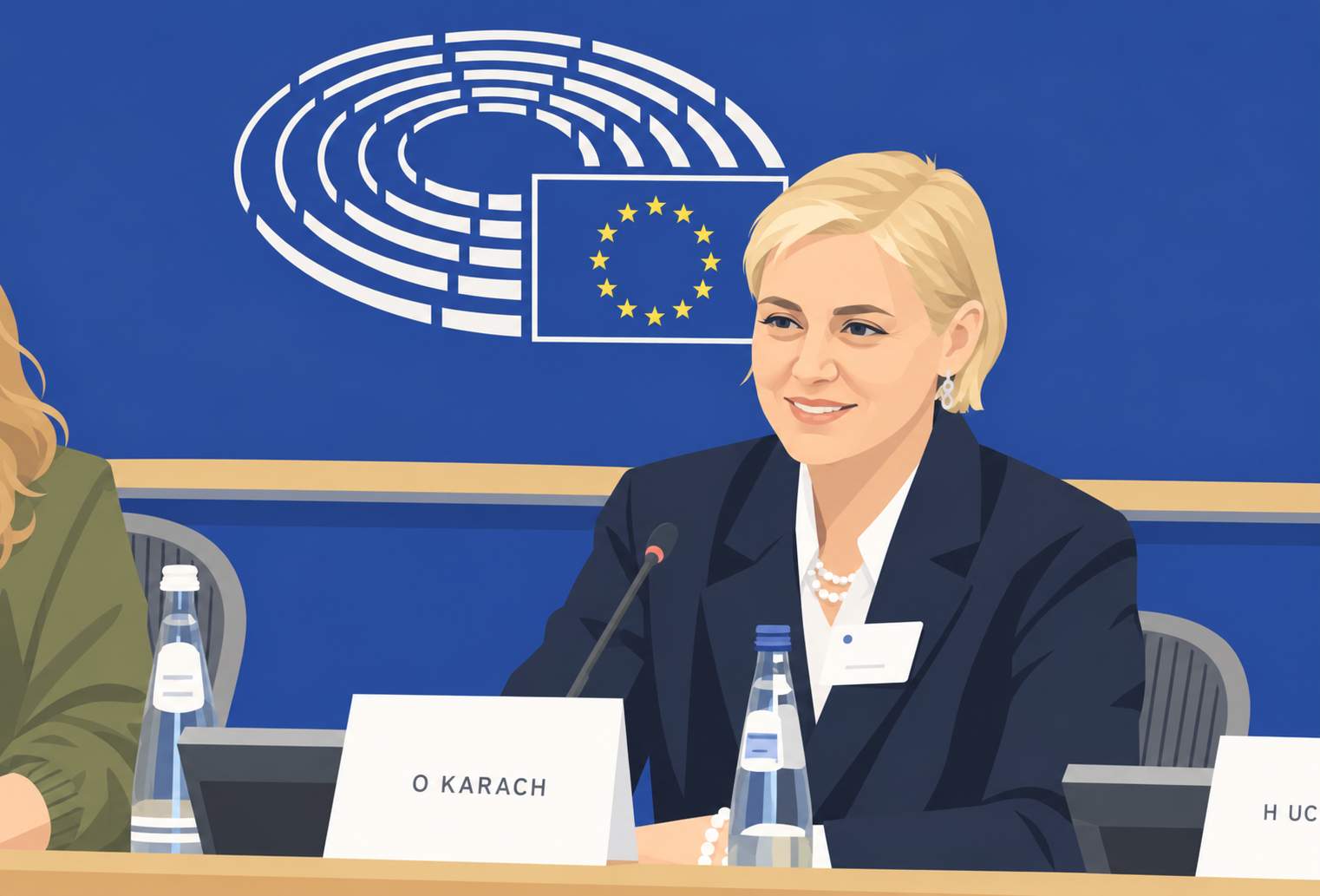
Belarusian human rights defender Olga Karach addressed European lawmakers on conscientious objection.
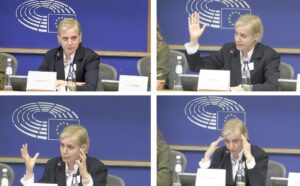
On 14 October 2026, Olga Karach, Belarusian human rights defender, Director of Our House and member of the Board of the European Bureau for Conscientious Objection (EBCO), delivered a speech at the European Parliament in Brussels during the international conference “Conscientious Objection is a Human Right!”
The conference was organised by The Left in the European Parliament and brought together Members of the European Parliament, human rights defenders, conscientious objectors and representatives of peace movements from Belarus, Ukraine, Russia, Türkiye, Israel and other countries.
The discussions focused on the right to refuse military service on grounds of conscience as a fundamental human right, the protection of conscientious objectors facing persecution, and the recognition of conscientious objection as grounds for international protection.
Our House extends its special gratitude to Özlem Alev Demirel, Member of the European Parliament representing Germany’s Die Linke party and The Left political group, for her initiative, leadership and important contribution to organising this international conference.
In her speech, Olga Karach addressed the contradictions between European opposition to the war in Ukraine and the lack of effective protection for Belarusian and Russian conscientious objectors who refuse to participate in military service.
Drawing on the experience of Our House and its “No Means No” campaign, she highlighted the persecution faced by conscientious objectors in Belarus, the difficulties they encounter when seeking asylum in European countries, and the risks of treating nationality as an indication of a security threat.
She also stressed that freedom of conscience and the right to conscientious objection must be universal and must apply equally to Belarusian, Russian and Ukrainian conscientious objectors.
Karach called on European institutions to recognise conscientious objectors and peace activists not merely as subjects of migration policy, but as independent actors for peace whose decisions to refuse participation in war can contribute to preventing violence and building a more peaceful future.
We publish the full text of Olga Karach’s speech delivered at the European Parliament on 14 October 2026.
Full speech:
Olga Karach — Full Speech Transcript
“Conscientious Objection is a Human Right!” · European Parliament, Brussels · 14 October 2026
When the war started, my colleagues and I were deeply shocked. And of course, our first question was: what can we, as Belarusian women human rights defenders living in exile, do to help Ukraine?
We sat together and discussed it, and finally we came up with one very crazy idea. We decided that what we could do was take the Belarusian army out of Lukashenka’s hands and prevent it from participating in the war.
We decided to launch a campaign called “No Means No”, because, as feminists, we believe that men also have the right to say no to patriarchy.
As a feminist and human rights defender, I have fought for women’s and children’s rights many, many times in my life. I cannot even count how many. I have always known how the patriarchal system puts pressure on women in so many ways.
But the campaign to protect Belarusian conscientious objectors is the first campaign in my life—and hopefully the last—in which I am fighting for men’s rights.
When we sat together, even I could not imagine how long and difficult the road would be to protect our men who do not want to participate in the war or serve in the military.
Of course, I expected pressure from the Belarusian regime, from Alexander Lukashenka. It was clear from the beginning that he did not like our campaign.
But what I did not expect was such strong resistance from the European side.
And today I want to speak about the paradox of European politics.
European countries condemn the war in Ukraine. Hundreds of resolutions, many very fine statements against the war in Ukraine—but almost no protection for men from Russia and Belarus who refuse to fight, go to war or serve in the military.
And this is what I really do not understand.
Why is it so difficult for migration authorities in Lithuania, Latvia, Estonia, Finland, France—everywhere—to accept the reasons why Russians and Belarusians do not want to join the army? Why don’t they understand this?
Now we see Russians and Belarusians trapped between two states.
I speak about Belarusians, of course, because this is my main focus.
In Belarus, we have the death penalty for desertion. Human rights defenders face punishment—up to five years in prison—if we help deserters and conscientious objectors.
They are imprisoned. They cannot obtain passports, open bank accounts or work legally.
At the same time, every year around 300 people in Belarus face prosecution or other forms of pressure for refusing military service.
In European countries, including Lithuania, where we now live, asylum applications are being rejected on a large scale. There are numerous security suspicions, and people are labelled as threats to Lithuania’s national security.
And the official accusation is still something so absurd that I cannot make sense of it.
The official accusation is that Belarusian conscientious objectors might be recruited by Russian or Belarusian intelligence services in the future.
How is it possible for someone in the European Union to be punished for something that might happen in the future?
This is a new chapter in international law.
Who can explain to me, as a Belarusian woman who has fought for human rights in Belarus for the past 25 years, how this is possible at all?
And of course, as human rights defenders, we are also under pressure in Lithuania and other European countries.
What I want to say is that a passport or nationality cannot, in itself, be evidence of a threat.
It is very strange that we are now being held collectively responsible for the men who started and support the war. I mean Putin and Lukashenka.
This is such a patriarchal approach.
In Belarus, we, as Belarusian women, are expected to be responsible for our men. We are responsible for their health. We have to accompany our men to the doctor. We are responsible for their well-being, their clean clothes—everything.
And why do I keep hearing that I am responsible for Alexander Lukashenka?
No. He is not my husband. He is not my partner at all.
And I keep hearing: “You are responsible. You are a Belarusian woman. You are responsible for what Lukashenka is doing.”
I reject this patriarchal approach in the European Union.
And something else is important: freedom of conscience and the human right to conscientious objection cannot be selective.
And yes, if we speak about Russian and Belarusian conscientious objectors, we must also speak about Ukrainian conscientious objectors.
It is impossible to speak about this selectively.
I have wonderful Ukrainian volunteers. I am a mother. I have a son.
I do not want my son ever, ever, ever to go to any war as a soldier.
And how can I go to a Ukrainian mother and tell her that her son must go to war, when I would never want that for my own son—or for the son of any Russian mother?
This is not acceptable at all.
And my last slide.
I am here because I want to ask you: stop treating conscientious objectors and peace activists in exile from Russia, Belarus and Ukraine as merely a migration issue.
We don’t want to be objects.
We want to be subjects—actors for peace.
I still believe in Europe as a common peace project.
I believe that conscientious objectors from Belarus, Russia and Ukraine can be subjects, can be actors for peace.
And peace in our region should not begin with peace negotiations alone.
Peace should begin with someone who says: “I don’t want to kill anybody.”
So please, let us fight together. We are on the right path as a very, very strong coalition supporting Belarusian, Russian, Ukrainian, Turkish, Israeli and all other conscientious objectors in wars around the world.
And I believe that conscientious objection is the least expensive, as well as a simple and sustainable, way to stop any war—especially the war in Ukraine.
Thank you very much.
Watch the video of Olga Karach’s speech at the European Parliament.