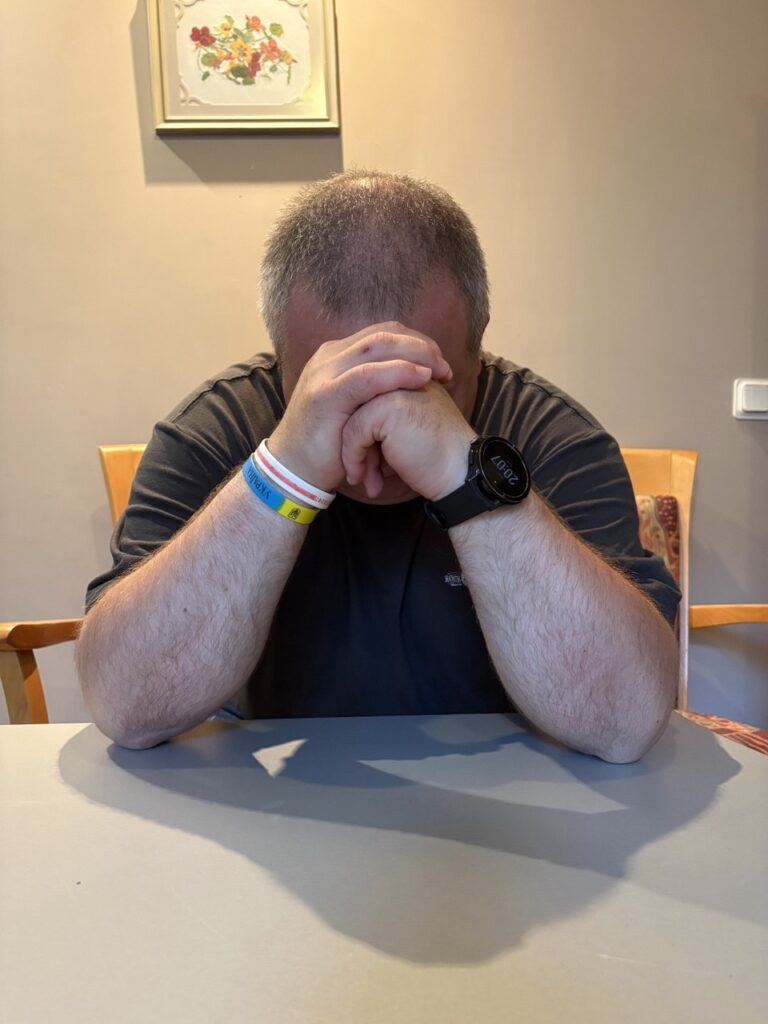

Russian prison authorities have blocked a letter from the human rights organisation Our House to 68-year-old anti-war activist Igor Odintsov, who was returned to Russia by Lithuanian authorities and subsequently sentenced to six years in a maximum-security penal colony.
Russian prison censors refused to allow a letter from Our House containing a question for anti-war activist Igor Odintsov to be delivered. We wanted to obtain his consent to lodge an application against Lithuania with the European Court of Human Rights.
Recently, we managed to obtain, from a Russian prison, the consent of anti-war activist Arianna Litvinova to lodge an application against Turkey with the European Court of Human Rights. As a reminder, Turkey deported Arianna to Russia, where she was taken into custody.
The situation was critical: the deadline for lodging an application with the ECtHR was about to expire, and we risked losing our last opportunity to obtain an international legal assessment of what had happened. For Arianna, who is being held in a Russian prison, this was virtually the only remaining path to justice.
Fortunately, we managed to obtain her consent in time, prepare the necessary documents and submit the application to the European Court of Human Rights.
We wish to express our particular and heartfelt gratitude to a private donor from Switzerland who covered the lawyer’s fees. It was thanks to this support that we were able to act without delay and lodge the application before the prescribed deadline expired.
Encouraged by this result, we decided not to stop there. This experience showed that even while in a Russian prison, a person can attempt to defend their rights before an international court. We therefore decided to reach out to 68-year-old anti-war activist Igor Odintsov.
Igor Odintsov’s Story
In January 1991, according to Sigitas Šamborskis, Igor Odintsov helped those defending Lithuania’s independence. On 17 September 2026, he himself swam across the Neman River, fleeing criminal prosecution in Russia over his anti-war statements. Following a screening involving Lithuania’s State Security Department (VSD), he was returned to the Russian authorities. On 30 September, a Russian military court sentenced him to six years in a strict-regime penal colony.
For a person of his age, such a sentence poses a serious threat to his life. We believe that the circumstances of Odintsov’s return to Russia by Lithuanian security officials, and the decisions they made to deport him to Russia, require an independent legal assessment.
Our House’s Letter Proposing an Application to the ECtHR Did Not Pass Russian Prison Censorship
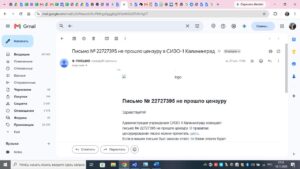
We sent Igor Odintsov a letter through the F-Pismo system to Pre-Trial Detention Centre No. 1 in Kaliningrad. It contained one fundamental question: did he consent to Our House helping him lodge an application against Lithuania with the ECtHR in connection with his return to Russia?
On 27 October, we received a notification: “Letter No. 22727395 did not pass censorship.”
The notification gave no reason for the blockage. But the contrast is striking: the correspondence that enabled us to obtain consent for an application against Turkey went through; the letter concerning a possible application against Lithuania did not.
Why Did Russian Censorship Block a Letter About an Application to the ECtHR Against Lithuania?
The situation raises questions. Following a decision by the Lithuanian authorities, Russian anti-war activist Igor Odintsov was returned to Russia, where he was subsequently sentenced to six years in a strict-regime penal colony. Now Russian prison censors have blocked our letter, in which we were trying to establish whether he agreed to apply to the European Court of Human Rights in connection with Lithuania’s actions.
The contrast is particularly surprising: in Arianna Litvinova’s case, we managed to obtain consent to lodge an application against Turkey with the ECtHR, whereas a letter asking an equivalent question concerning Lithuania did not pass Russian prison censorship.
Why was correspondence necessary for an application against Turkey possible, while a letter concerning a possible application against Lithuania was blocked?
We are not claiming that any arrangements exist between Russian and Lithuanian security agencies. We do not yet have evidence of such cooperation. Nevertheless, it is difficult not to notice that, in this case, the actions of the security agencies of two countries that are publicly at odds with each other, regardless of their motives, led to extremely adverse consequences for the same anti-war activist.
A legitimate question arises: why do the decisions of Russian and Lithuanian state bodies in this case effectively hinder the protection of the rights of a person who spoke out against the war in Ukraine?
For now, there is no answer to this question.
Human rights must not depend on which state a person intends to bring a case against. They are universal.
Our House will continue its efforts to establish contact with Igor Odintsov, determine the reasons for the censorship and secure an independent review of Lithuania’s compliance with the principle of non-refoulement.