
How We Met Nikita and Why He Faces Being Sent Back to Belarus
Behind every statistic, every dry line in a court ruling, a migration decision or another official document, there is a human life.
We want to introduce you to some of the people Our House works with, above all so that you can understand just how difficult it can be to help someone when one version of their story appears in their personal account, another in their migration file and a third in court. And yet a decision made almost absent-mindedly by someone sitting at a desk in a warm, comfortable office, with a coffee machine nearby, determines where that person will be taken tomorrow and what will happen to them. Only in propaganda is everything neatly divided into black and white, with everyone told who belongs and who does not. I want to tell you instead how, in the summer of 2022, I met a Belarusian deserter for whom we were searching for shoes, while he stood right beside us helping unload a humanitarian aid truck.
A Pair of Size 48 Shoes
When Russia’s full-scale war against Ukraine began in 2022, our wonderful German partners from the human rights organisation IGFM, the Wittlich Working Group, were actively sending truckloads of humanitarian aid to Latvia, Lithuania and Poland. Those deliveries were a lifeline to us and helped an enormous number of refugees. Ukrainians and Belarusians were crossing borders, many with nothing but a backpack. Public institutions were overwhelmed and struggling to cope. There was a shortage of clothes, shoes, everything. I remain deeply grateful to our German partners and to our volunteers, who unloaded, sorted and distributed all those supplies. Thanks to them, we managed to withstand that first wave. Hundreds of people passed through our office every day. Their faces blurred into one vast, colourful tapestry; we could barely tell day from night. Our humanitarian distribution centres operated almost around the clock. Our volunteers slept, ate and, in effect, lived in our offices and warehouses.
That Sunday, when another humanitarian truck arrived in Vilnius, our Belarusian, Russian and Ukrainian volunteers came to unload it together. To understand what that Sunday meant, imagine people who had themselves fled their countries, who were working two or even three jobs, exhausted and desperately short of rest. On the one day when they might at least have slept in, they came to help us unload a truck, entirely as volunteers. I have never forgotten that they gave us their Sunday.
So there we were, unloading the truck and carrying boxes, when someone called me and said:
“Olga, a Belarusian deserter has just made it to Lithuania. He’s a big lad with enormous feet. Could you see whether you’ve got any shoes for him? Size 48, I think. Have a look around.”
I said we’d see what we could find. At that very moment, one of our Ukrainian volunteers stumbled and fell while carrying a box packed to the brim with shoes. Shoes scattered everywhere. Everyone rushed to pick them up, and a pair of men’s shoes landed right at my feet. I picked them up, checked the size and saw that they were a 48.
“Oh, these are just right for our Belarusian deserter.”
And then a young man standing next to me, passing boxes along just like everyone else, said:
“But I’m the deserter.”
I looked at him, smiled a little and assumed it was his nickname. Back then, people invented all sorts of names for themselves. One called himself Stool, another Hand of God, another Woof the Dog, and yet another Rain God. You never knew what name someone would give you, or whether it was a name at all, especially if they had relatives still in Belarus whom they were trying to protect from the KGB. People hid behind pseudonyms to preserve at least some anonymity. In Belarus, our humanitarian work and assistance to Belarusian refugees in Lithuania, Latvia, Poland and elsewhere fall under the criminal offence of “extremism”, punishable by up to seven years in prison. Naturally, people did whatever they could to conceal their identities. So I glanced at him and carried on working. But when we mentioned again that we needed to set aside the shoes for the deserter, he came over once more.
“But I am the deserter!”
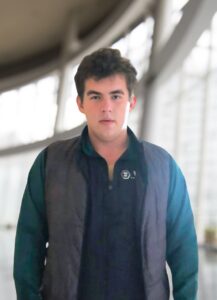
That was when we finally started talking. It turned out he really had fled the Belarusian army the day before. He was terrified that his unit would be sent to fight against Ukraine, and he wanted neither to kill nor to be killed. His name was Nikita. When he crossed the border in May 2022 and applied for asylum in Lithuania, he hoped that a country which constantly proclaimed its support for Ukraine would surely take him in rather than hand him back.
“They’ve Kidnapped Our Deserter!”
After we finished unloading the truck, we took Nikita back to our office. We were sitting there chatting, drinking coffee and eating cake, while he told us in detail how he had crossed the Lithuanian-Belarusian border illegally. Suddenly the door flew open and one of our volunteers burst in, breathless and visibly distraught.
“Olga, we need to raise hell, right now! Alert everyone! The KGB has kidnapped our deserter from the refugee centre! They’re driving him to the border in the boot of a car, with his hands and feet tied!”
“Another one? How many deserters have we got now?”
We later pieced together what had happened. There was not much to do on a Sunday at the refugee centre outside Vilnius. Nikita was wandering around, frankly bored, when he met several Belarusians preparing to go into town to unload our humanitarian truck.
“Listen, you’re a strong young fellow. What are you going to do hanging around here? Come with us and lend a hand. You’ll need to come and collect clothes from there anyway. You might as well help out.”
They took him along without properly telling anyone. The whole cheerful group headed into Vilnius, and nobody at the centre knew where Nikita had gone. As luck would have it, just after he left, a man turned up who, we were later told, introduced himself as an employee of the Belarusian embassy. He had come to persuade Nikita, the deserter, to return to Belarus.
We never found out who he really was. But just imagine how important it must have been, in my view, for the KGB to get this runaway soldier back if someone was prepared to travel out to a refugee centre on a Sunday to speak to him in person. The visitor walked around, asked questions, failed to find Nikita and left. Meanwhile, the other Belarusians realised that the visitor had gone, Nikita was nowhere to be found, and nobody could explain where he was.
All hell broke loose. The entire diaspora was in an uproar. People were convinced that the Belarusian embassy had abducted our deserter, restrained him, bundled him into a car boot and was speeding him towards the Belarusian border to hand him over to the KGB and send him to prison. People started calling one another, and others rushed to us for help, desperate to raise the alarm before he was taken across the border. These were people who had themselves fled repression and knew what the Belarusian security services were capable of. It is hardly surprising that this was what they feared, or that their imaginations ran to the worst possible scenarios.
Meanwhile, completely unaware of the commotion, we were sitting with Nikita, drinking coffee and eating cake. He was calmly telling us how he had reached Lithuania, with no idea that the entire Belarusian diaspora was frantically searching for him.
And so a German humanitarian aid truck in Lithuania saved one Belarusian deserter from an unwanted encounter with the Belarusian embassy and the KGB.
That is how I met Nikita. He went on to help us distribute humanitarian aid many times. He was a strong young man, there was plenty of work, and no shortage of people who needed clothes and food. Someone had called us to find him shoes, but he had come himself to carry boxes of supplies for other people. That is what genuine solidarity looks like.
“The KGB Gave Me Their Word of Honour”
According to Nikita, the KGB even recruited his former girlfriend, whom he had loved very much. She called him several times, urging him to return and saying:
“You don’t understand. The KGB officers gave me their word of honour that if you come back, nothing will happen to you. They promised me you wouldn’t be sent to prison.”
I think about what it must be like to hear those words from someone you once loved, when the people speaking through her are the very people you fled. Belarusians carry a powerful collective memory. We understood perfectly well what a “KGB word of honour” might be worth if Nikita returned. I feared that he could face a show trial, perhaps even the death penalty. In Belarus, desertion to a NATO country can be treated as “high treason”, a charge that carries the death penalty. In my view, the Belarusian authorities had every reason to avoid a precedent in which a soldier refused to fight, escaped the army, reached Europe and was actually welcomed there. Other soldiers might then realise that they, too, had a choice and begin deserting the Belarusian army.
And this is where, in my view, Lithuania once again sided with the interests of the Belarusian regime. In November 2023, the Migration Department refused Nikita both asylum and subsidiary protection, despite knowing that he feared the death penalty in Belarus. The Department considered that risk unsubstantiated. His appeal did not secure protection. Then, in the summer of 2024, he was first ordered to leave for Belarus, followed by a decision providing for his forced removal and deportation to Belarus. Previously, the KGB had tried to persuade him to return voluntarily, passing assurances of safety through his former girlfriend and promising that no harm would come to him. Now, following the Lithuanian authorities’ decision, he faces the very real prospect of being returned by force. What the Belarusian KGB failed to achieve through persuasion and promises may now be accomplished by the Lithuanian migration authorities.
For three years, Nikita has been living without legal status and hiding from the migration authorities. Three years without documents, a bank account, access to a doctor, lawful employment or any prospect of a future. The entire “crime” of this kind, good-natured, rather plump young Belarusian man is that he refused to kill Ukrainians and decided that under no circumstances would he go to the front in Ukraine. For three years, the Belarusian and Lithuanian authorities have pursued him, seeking to punish him for refusing military service and refusing to kill Ukrainian civilians: women, children and elderly people.
Today, Nikita could be deported to Belarus at any moment. There he faces criminal prosecution and ill-treatment; if the Belarusian authorities charge him with high treason, I fear he will simply be executed. Since 25 March 2023, Belarusian law has provided for the death penalty for military personnel convicted of high treason. We fear that Nikita’s departure from his unit, and what he told the Lithuanian authorities about what he witnessed during his service, could be used against him in Belarus.
Whenever I reread the deportation decision, I remember that Sunday three years ago, when our distressed volunteer burst into the office, genuinely convinced that Nikita was already being driven to the border. And I remember being able to say to her: “What do you mean, kidnapped? He’s right here, sitting with us!” We all breathed a sigh of relief that day.
But nothing has been resolved. For Nikita, the Belarusian deserter, everything remains as it was. The only difference is that this time it may not be the Belarusian embassy or the KGB that takes him to the Belarusian border and into a Belarusian prison, handcuffed or otherwise. It may be Lithuania’s migration authorities, acting together with the country’s national security authorities, who deliver him into the hands of the KGB.
At least, it seems, no one else is deserting the Belarusian army for a NATO country. Lithuania has achieved its aim and given Lukashenko considerable help in strengthening the Belarusian army.
Today, Belarusian deserters have nowhere left to flee.
Olga Karach
Belarusian Human Rights Defender