
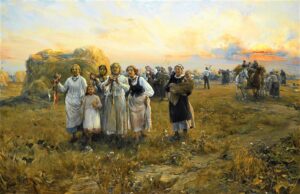
In Belarusian folk tradition, Dazhynki marked the end of the harvest. People thanked one another for their hard work, wove wreaths from ears of grain, ceremonially brought in the final sheaf and gathered around a shared table. A few ears of grain were left uncut in the field — the “beard”, associated with hopes for fertility and the next harvest. It was a celebration of community, shared labour and the continuity of life. You can see this in the painting Dożynki by the Polish artist Alfred Wierusz-Kowalski.
Under dictator Alexander Lukashenko, this tradition has been repackaged by the state. The national festival dates back to 1996, when it was first hosted by Stolin. An entire system of formal ceremonies, awards and preparations in host towns has grown up around the celebration.
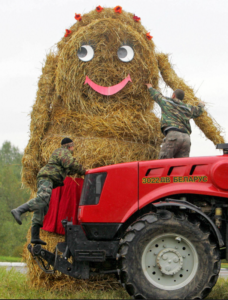
In Lukashenko’s version, officials have a harvest of their own: collecting expressions of gratitude, presenting the right image and reporting prosperity to the dictator.
Residents themselves have sometimes had to pay for these polished façades. In 2013, Radio Svaboda reported that, ahead of Dazhynki in Zhlobin, private homeowners were being forced to paint their façades, roofs and fences under threat of fines. An elderly resident said she had spent the savings she had set aside for her funeral to comply with the demands. That was the reality behind the festive facelift.
Now, the militarisation of childhood is being added to this harvest of official pomp.
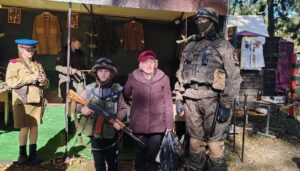
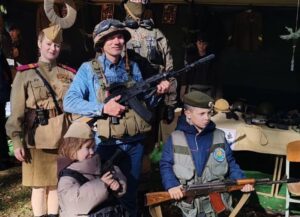
On 10 October 2026, at the regional Dazhynki festival in Shklou, Klimavichy State Agrarian College was represented by members of the “For the Motherland!” military-patriotic club. They introduced visitors to museum exhibits dedicated to the Great Patriotic War. Nearby, an area called “Rest Stop” featured a field kitchen and soldiers’ porridge.
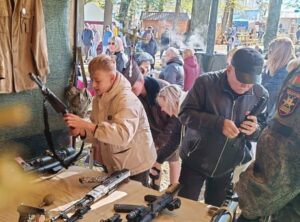
An agrarian college could have showcased career opportunities, technologies and student projects. Instead, a military club took centre stage in its festival programme.
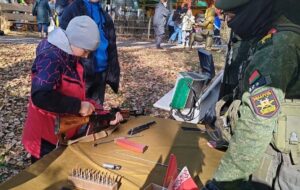
For Our House, this is a troubling example of how the military agenda is being woven into civilian life. The familiar atmosphere of celebration makes it seem normal and appealing, providing a convenient vehicle for promoting it among young people.
Remembering war requires a discussion of the lives lost, families torn apart and the experiences of civilians. Its most important purpose is to help society prevent further violence. Presenting military life as part of a festive spectacle risks obscuring that purpose.
We stand for education that fosters independence, professional knowledge and respect for human dignity. Students must be free to hold peaceful convictions and choose their own forms of civic engagement.
The folk tradition of Dazhynki reminds us of the value of peaceful work and mutual aid. These are the values that should be restored to a festival the authorities have buried under bureaucratic reports, sham displays and military paraphernalia.