

A Russian conscientious objector faces deportation; urgent legal defence needs your support.
In 1940, Chiune Sugihara, a Japanese diplomat representing the Japanese Empire, was stationed in Lithuania. By issuing Japanese transit visas without instructions from Tokyo, he helped more than six thousand Polish and Lithuanian Jews fleeing Nazi persecution escape the country. Sugihara was extraordinarily lucky, however: Lithuania did not yet have its present-day State Security Department. Otherwise, who knows, perhaps he and the six thousand Jews he helped would have been sent straight to the gas chambers, branded a “threat to Lithuania’s national security” and accompanied by the sneering jokes of Lithuanian security officers about a “free taxi to the concentration camp”. For anyone unfamiliar with the reference, we hear that some Lithuanian security officers now make similarly “witty” remarks about a “free taxi to the border” when discussing the deportation of Russians and Belarusians to places where they face imprisonment.
New times bring new groups of people fleeing war, prison and persecution.
Today, young Russian and Belarusian men are fleeing military service and war, yet behind the words “protection of conscientious objectors” there is almost never just one legal procedure. Instead, there are years of struggle spanning several countries, endless paperwork and correspondence, court decisions, fresh complaints, the constant fear of deportation, undeclared work, and life without medical care or bank accounts. And hanging over all of this is a question that grows more frightening for us every day: will we manage to help someone before they are sent back to the country they fled — Belarus or Russia — where they may be imprisoned for refusing military service and holding anti-militarist convictions?
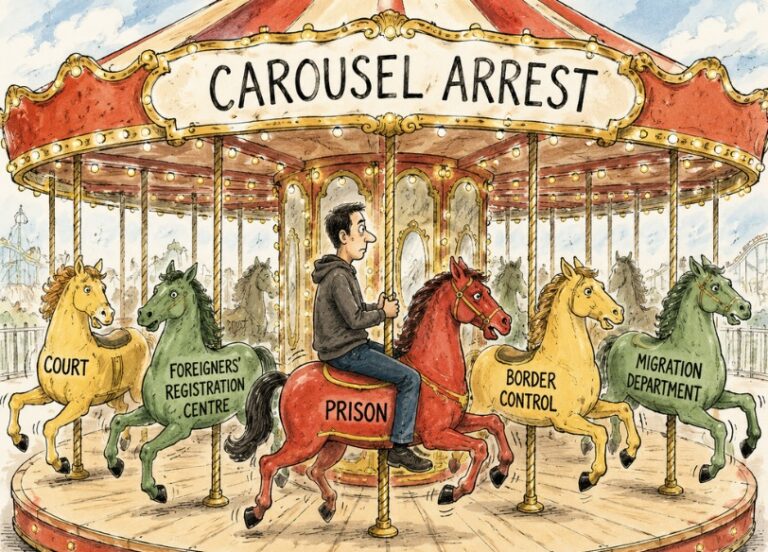
Daniil is a young Russian man who opposes the war against Ukraine and does not want to serve in the Russian army. He refused to service military transports, and when he first tried to escape by hiding in a freight wagon, FSB officers caught him and, mistaking him for a Ukrainian spy, beat him with a bag over his head. Eventually, he bought a ticket for a train to Kaliningrad and jumped from the moving carriage, risking his life because all he wanted was to find safety in Europe. Yet instead of a clear route to protection and solidarity with his anti-war stance, he found himself trapped in a chain of decisions in which each successive country tries to push responsibility back onto the previous one, while the final destination remains Russia.
Lithuania promptly opened criminal proceedings against him for crossing the border illegally, while the Lithuanian media launched what amounted to a campaign of harassment. Finland, citing the Dublin rules, refused him protection and decided to transfer him to Lithuania. We applied to the European Court of Human Rights three times for urgent interim measures under Rule 39, and all three applications were refused. France, where Daniil subsequently sought protection, likewise ordered his transfer to Lithuania under the Dublin rules, and his appeal before the French courts was unsuccessful. On 24 August 2026, Our House submitted another urgent Rule 39 request to the European Court of Human Rights, which was also refused. On 11 September, we lodged the main application against France with the Court. And so, in the case of just one person, a single Belarusian human rights organisation, Our House, has already managed to leave its “footprints” at the ECtHR through applications concerning Lithuania, Finland and France.
As human rights defenders, there is one thing we genuinely cannot understand: why, while Russia is waging war against Ukraine, is it so difficult to explain to the migration authorities of European countries that a young Russian or Belarusian man may oppose that war, that he may not want to take up arms, serve in the army of an aggressor state or become part of its war machine? Why is it precisely the person who refuses to participate in aggression who becomes so inconvenient for the European protection system that even the most basic security, in the form of a humanitarian residence permit, is so difficult to obtain?
We are not asking anyone to take a person at his word without checking the facts; we are asking that his refusal to participate in war, the persecution he has endured and the risks of return be examined seriously, individually and on their merits. Instead, we watch the legal procedures of different countries form one long chain, at the end of which, for some reason, Russia or Belarus keeps appearing, while every new link requires another lawyer, another urgent application and another substantial sum of money that we simply do not have.
We were only able to prepare the latest application against France on credit, because the filing deadline was approaching and there was no time to wait. Once again, we asked lawyers to do the work now and accept payment later, and they agreed. But how many more times can we ask people to work on credit when we do not even know when we will be able to pay them?
We do not lack in-house lawyers because we fail to understand how essential they are; we lack them because lawyers, too, need to be paid regularly. Without a permanent legal team, every urgent case has to be assembled from scratch, and one-off assistance is extremely expensive. Organisations that supported us in the past tell us frankly that they have already done a great deal — and that is true: since 2022, they really have done an enormous amount for us, and we are deeply grateful. But that does not make new cases or new deadlines disappear.
There have already been cases in which Belarusian and Russian conscientious objectors were deported from Lithuania and we could not secure the legal assistance they needed, because lawyers cannot work without pay indefinitely. Perhaps that is the hardest part of all: knowing that the possibility of protecting someone depends not only on the law and the evidence, but also on whether there is still money available before the procedural deadline expires.
Today, we need to raise €1,800 to pay for the legal work in Daniil’s case: €1,200 for the main application and €600 for the urgent Rule 39 request. These figures are not abstract organisational expenses; they represent work that we have already had to arrange for a person who faces being transferred from one country to another, with a Russian prison potentially waiting at the end of the road.
We often assume that refusing to take part in war should be an understandable decision, yet in practice Russian and Belarusian conscientious objectors all too often discover that nowhere is prepared to welcome them. They are required to prove that they genuinely do not want to fight and then, again and again, to prove that sending them back would be dangerous.
What are we supposed to do? Accept that someone who refuses to serve in the army or participate in war should be left without protection? Stop filing applications because they cost too much? Admit that the right to asylum exists only for wealthy refugees who can afford to pay their way through every last legal instance? But wealthy and privileged refugees can manage without us: they have enough money and resources to navigate the system themselves.
Human rights must not depend on how much money, power or access to resources someone has.
We cannot accept this, which is why we are asking you to help us pay off the debt incurred for Daniil’s legal defence. Every contribution will reduce the amount that currently stands between the work we do today and our ability to continue it tomorrow — and perhaps spare us from having to tell the next conscientious objector: “We understand that you are in danger, but we no longer have the money to pay a lawyer.”
Donation link:
https://www.ndbelarus.com/2026/10/18/daniil-ecthr-legal-defense/

You can read Daniil’s human rights case file here.
Human Rights Dossier
Daniil Mukhametov

Prepared by: Our House Centre for Human Rights and Relief
Date of birth: 5 April 2004
Citizenship: Russian Federation
Current location: France
Date: September 2026
Updated version: October 2026
1. Executive Summary and Protection Sought
Daniil Mukhametov is a railway worker, a conscientious objector and an anti-war activist. He fled Russia to escape further persecution and forced conscription into military service.
The French authorities have decided to transfer Daniil to Lithuania, where a criminal case has been opened against him for allegedly crossing the border illegally after escaping from a Russian transit train.
There remains an immediate threat of chain deportation: France → Lithuania → Russia.
Our House insists that Daniil’s transfer to Lithuania be cancelled and that he be granted effective international protection in France.
2. Persecution in Russia and Reasons for Fleeing
Daniil is an electrical fitter specialising in the repair of electrical equipment. He worked as a passenger carriage attendant for JSC FPC in Moscow and later as an electromechanic on the railway in Ufa. He studied at Kolomna College.
While working for Russian Railways (RZD), Daniil refused to service military rail transports and was subjected to pressure from his employer and the military enlistment office. He was subsequently transferred from Moscow to Ufa.
After Daniil fled Russia for Lithuania to escape persecution and forced conscription, he was dismissed on the stated grounds of “unauthorised absence from work”.
On 19 August 2024, Daniil was detained in Ruzaevka by plainclothes officers of the Federal Security Service (FSB). They beat him, used a plastic bag to obstruct his breathing, and forced him to unlock his mobile phone. He spent the night in custody.
On 20 August, the Ruzaevka District Court of the Republic of Mordovia sentenced him to five days of administrative arrest. The ruling classified his actions as petty hooliganism involving disobedience of a lawful order from a police officer. The administrative arrest was imposed without adequate procedural safeguards.
Daniil was then taken to a pre-trial detention facility in Saransk and handed over to FSB officers for a four-hour interrogation using a polygraph. He was subjected to cruel treatment there. After serving the five days of administrative arrest, Daniil was released, went into hiding and sold his phone to avoid surveillance.
On 9 January 2025, Daniil attempted to enter the EU via Türkiye but was refused entry because he did not have a Schengen visa. He was forced to return to Russia.
A summons Daniil received from the military enlistment office required him to report at 2:00 p.m. on 11 March 2025 to the military commissariat for Domodedovo and the Leninsky Urban District in Moscow Region for procedures related to conscription. Daniil did not report to the commissariat. He applied for a deferment on health grounds and began receiving follow-up care from a psychiatrist, who prescribed antidepressants.
Daniil remains registered for military service in Russia without a deferment or exemption from conscription. A medical record dated 14 July 2025 refers to a previously assigned medical fitness category “A”.
Following the torture, Daniil remains under psychiatric care and takes antidepressants. On 14 July 2025, the Terveystalo Kamppi medical centre documented mental health problems and prescribed treatment. The medical record also contains his account of the violence he suffered, subsequent fear, anxiety and sleep disturbances, as well as information about earlier consultations for psychiatric care.
3. Escape through Lithuania and Criminal Prosecution
On 17 June 2025, Daniil jumped from the Russian transit train “Adler – Kaliningrad” in Lithuania. He held a Facilitated Rail Transit Document (FRTD) for his journey through Lithuania.
After leaving the train, Daniil reached Kaunas and intended to seek asylum in Lithuania. However, reports that he was being searched for and the publication of a photograph of his passport in Lithuanian media made him afraid to approach the Lithuanian authorities. He continued his journey and sought international protection in Finland.
After Daniil left the train, the Marijampolė County Police opened administrative offence proceedings over an alleged breach of the rules governing transit through Lithuania.
The border guard service found no grounds to open a criminal investigation. Its representative explained that Daniil had entered Lithuania lawfully through the Kena border checkpoint, after presenting the required documents.
However, on 3 July 2025, a prosecutor overturned the border guard service’s decision not to open a criminal investigation and ordered an investigation into Daniil’s alleged unlawful crossing of the state border.
A man who fled torture, persecution and forced participation in the war now faces criminal punishment in the EU for the very way he escaped.
On 21 July 2025, Daniil was entered in Lithuania’s official register of wanted persons as a suspect. The search was initiated by the Pagėgiai Border Guard District of the State Border Guard Service under the Ministry of the Interior of the Republic of Lithuania. Daniil has been declared internationally wanted.
In May 2026, the Kaunas Regional Prosecutor’s Office stated that Daniil remained a suspect in the case concerning his alleged unlawful border crossing. The Lithuanian authorities continue to seek his transfer to Lithuania.
Lithuanian media and public statements portrayed Daniil as a “Russian saboteur” and a “threat to national security”.
Our House believes that such public rhetoric effectively rules out the possibility of fair and impartial proceedings for Daniil in Lithuania.
4. Attempts to Obtain Protection in Finland and France
In Finland
On 18 June 2025, Daniil applied for international protection in Finland.
The Finnish authorities considered that Lithuania should examine Daniil’s application because it had issued him a document for rail transit. On 6 August 2025, Lithuania agreed to accept him.
On 5 September 2025, the Finnish Immigration Service (Migri) declined to examine Daniil’s application for international protection on the merits: the Finnish authorities held that Lithuania should decide whether to grant him protection. At the same time, Migri refused him a residence permit, ordered his removal to Lithuania and imposed a two-year ban on entering Finland.
When making its decision, the Finnish authorities had the medical report and human rights documentation from Our House concerning the circumstances of Daniil’s case and the risk of deportation to Russia.
On 16 September 2025, the Helsinki Administrative Court rejected Daniil’s request to temporarily suspend his removal to Lithuania while his appeal against Migri’s decision was being considered. The court was to rule on the appeal itself at a later date.
In December 2025, the appeal was finally dismissed. Daniil then left Finland and made his way to France.
In France
On 29 December 2025, Daniil applied for international protection in France. The French authorities first asked Finland to accept his transfer. Finland refused, citing the transit document issued to him by Lithuania.
On 4 February 2026, France asked Lithuania to accept Daniil’s transfer for the examination of his application for international protection. On 20 February, the Lithuanian authorities agreed to accept him.
On 4 June 2026, the Prefect of Bas-Rhin ordered Daniil’s transfer to Lithuania. At the same time, Daniil was required to reside for 45 days at a location designated by the authorities within the Bas-Rhin department.
Daniil challenged the prefect’s decisions. The hearing took place on 17 June 2026. On 26 June, the Strasbourg Administrative Court dismissed his appeal. The court found that the evidence submitted was insufficient to overturn the transfer decision, despite arguments concerning criminal prosecution in Lithuania, the risk that his application for international protection would not be examined fairly there, and the risk of subsequent deportation to Russia.
On 17 July 2026, a protest was held in Paris in support of Daniil and against his transfer to Lithuania.
The transfer decision was subsequently challenged before France’s highest judicial authority. All avenues for further appeal against this decision in France have been exhausted.
On 24 August 2026, Our House asked the European Court of Human Rights to urgently suspend Daniil’s transfer from France to Lithuania. The Court refused to grant this interim protective measure.
On 11 September 2026, Our House lodged an individual application against France with the European Court of Human Rights in Daniil Mukhametov’s case.
5. Legal Assessment and Risk of Return
Daniil has already been subjected to torture and arbitrary detention in Russia. His anti-war beliefs and conscientious objection to military service must be taken into account when considering whether to grant him refugee status. If returned, he faces renewed arrest, torture, fabricated criminal charges for “discrediting the army” and “refusal to serve”, as well as conscription or mobilisation. Our House Centre for Human Rights and Relief considers Daniil’s return to Russia unacceptable and insists that he be granted international protection.
In Lithuania, Daniil faces criminal punishment for the way he fled Russia. Unlawful border crossing is punishable by up to two years’ imprisonment. At the same time, Lithuanian law provides an exemption from criminal liability for a foreign national who entered unlawfully for the purpose of exercising the right to seek asylum. The assessment of Daniil’s case must take into account his initial intention to seek protection in Lithuania, his fear of approaching the local authorities, and his subsequent asylum application in Finland. Punishment for the way a person escaped must not take the place of protection from torture and persecution.
Public stigmatisation of Daniil further threatens his right to a fair hearing and heightens the risk of his being deprived of liberty.
Daniil’s transfer from France to Lithuania cannot be considered separately from the risk of his subsequent deportation to Russia. The principle of non-refoulement prohibits returning a person to a country where they face a risk of torture, including via another country. France has the right to examine Daniil’s application for international protection itself, even if Lithuania has been designated the responsible state, but simply chose not to do so.
If he is transferred to Lithuania, there is a high risk that he will be arrested and held in detention.
6. Demands of Our House
France
Cancel the decision to transfer Daniil to Lithuania. Examine his application on the merits and grant him international protection in France, either refugee status or subsidiary protection.
Lithuania
End the criminal prosecution of Daniil and terminate the international search for him. Refrain from politicised rhetoric in the media and ensure fair and impartial proceedings. Ensure Daniil has unhindered access to an effective international protection procedure.
Under no circumstances deport or transfer Daniil to Russia while he faces a risk there of torture, persecution or forced conscription into military service.
Finland
Provide Daniil and his representative with the documents and decisions relating to his case that they need for his further protection, and ensure access to all case materials.
UNHCR, the ECtHR and the European Commission
Place Daniil Mukhametov’s case under urgent monitoring and international oversight. Support urgent protective measures to prevent a transfer that could lead to torture, political persecution or Daniil’s forced conscription in Russia. Take into account his particular vulnerability as a victim of torture, a conscientious objector and an anti-war activist.