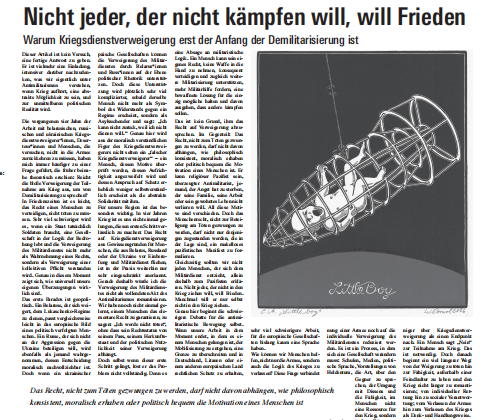

FriedensForum publishes Olga Karach’s article on defending human rights while in exile.
The German peace movement magazine FriedensForum has published an article by Belarusian human rights defender Olga Karach, head of Our House, on the challenges of peace work in exile. The article appears in issue 6 for November–December 2026, on pages 61–62.
Published under the title “Herausforderungen der Friedensarbeit im Exil: Ein Blick aus Belarus” (“The Challenges of Peace Work in Exile: A Perspective from Belarus”), the article explores how to remain committed to universal human rights amid war and growing pressure on independent voices.
Olga Karach examines the contradictions activists encounter after being forced to leave their country. Opposition to authoritarianism in Belarus receives support in Europe. Yet defending the same principles in a country that has granted refuge can arouse suspicion when it challenges government decisions on security.
She emphasises the distinction between systematic repression in Belarus and conditions in democratic countries. Her focus is on the mechanisms through which exceptions to common rules gradually become acceptable. When military threats are invoked, particular scrutiny is needed to ensure that human rights are respected and space for public debate is preserved.
The article also addresses the situation of conscientious objectors, deserters and former combatants from Belarus, Russia and Ukraine. Drawing on her experience of working with them, Olga Karach explains that war continues to affect people after they cross a border or take off their uniform. It persists in social relationships, political language and the habit of dividing people into “us” and “them”. Supporting those who leave war behind is essential to lasting peace and security.
It also examines the pressures that can accompany life in exile: campaigns to discredit individuals, administrative decisions, banking restrictions, the loss of partners and funding, and digital targeting. Karach highlights the cumulative impact of these measures, which can undermine a person’s ability to continue their work.
The central question is whether human rights remain universal when defending them becomes politically inconvenient. Freedom of expression, the independence of the legal profession, the right of civil society to challenge government decisions and the right to conscientious objection require particular protection during wartime.
Our House thanks the editors of FriedensForum for publishing Olga Karach’s article and providing an opportunity to share the experience of Belarusian civil society with a German-speaking audience. We value their willingness to make room for discussion of difficult questions concerning war, exile and the responsibilities of democratic states.
We thank the editors for their attention to people who refuse to participate in violence, their support for independent dialogue on peace, and their solidarity with those who continue their human rights work in exile.