
Olga Yevgenyevna Karach (Belarusian: Volha Yauhenawna Karach; born 5 January 1979, Vitebsk) is a Belarusian human rights defender, journalist, civic and political activist, founder and head of the International Centre for Civil Initiatives “Our House”. Her main areas of work include women’s and children’s rights, civic participation, transparency and accountability of public authorities, nonviolent resistance, peacebuilding, protection of refugees, protection of conscientious objectors to military service, and nuclear disarmament. [1][2][3][4]
From 2003 to 2007, she served as a deputy of the 24th convocation of the Vitebsk City Council, where she was the only opposition representative and the youngest member of the council. She founded the newspapers Vitebsk Courier and Our House, created the public oversight initiative Chinovniki.info, and hosts the YouTube channel Our House TV, which has accumulated around 43 million views and an audience of approximately 80,000 subscribers. [1][5][6][7][8][9]
She is a recipient of international awards in the fields of human rights, civil courage and peace, including the Bremen Peace Award, the Human Rights Award of the City of Weimar, and the Alexander Langer International Prize. The organisation she leads, Our House, was one of the joint recipients of the 2023 Seán MacBride Peace Prize. Since March 2020, Karach has lived and worked permanently in Vilnius. In July 2024, she was sentenced in absentia in Belarus to twelve years’ imprisonment and a large fine; her case became the subject of international protection campaigns and a communication by UN special procedures.
She has been recognised as a political prisoner in Belarus.
[10][11][12][13][14][15][16]
Awards and international recognition
Olga Karach’s human rights, civic and anti-war activities have been recognised by awards from prominent international civil society organisations, peace movements and European municipalities.
2005 — “Human Rights Defender of the Year” award of the Belarusian section of Amnesty International (Amnesty International Belarus Human Rights Awards). [17]
2010 — Radebeul Courage Prize (Radebeuler Courage Preis), Germany. [1]
2019 — International Bremen Peace Award of the die schwelle Foundation in the category “Grassroots Peace Worker” (Friedensarbeiterin an der Basis). The citation highlighted the development of a civic network, exposure of abuses and campaigns aimed at holding politicians accountable. [11]
2022 — Human Rights Award of the City of Weimar, Germany. The city recognised her campaigns for fundamental rights, equality, children’s rights and the protection of people subjected to repression. Her award was also reported by Stanford University’s Center on Democracy, Development and the Rule of Law (CDDRL). [10][18]
2023 — Alexander Langer International Prize (Premio internazionale Alexander Langer), Italy. [12]
2023 — Seán MacBride Peace Prize of the International Peace Bureau: a joint award to Our House, the Russian Movement of Conscientious Objectors and the Ukrainian Pacifist Movement for defending the right to conscientious objection to military service and for peacebuilding activities. Karach represented Our House. [13][19]
2024 — Ludwig Baumann Prize (Ludwig-Baumann-Preis) of the Carl von Ossietzky Solidarity Fund affiliated with DFG-VK, Germany, for anti-war activities. The award ceremony took place in Halle on 4 October. [20][21]
2025 — Premio Brescia per la Pace, Italy. The award was presented for the defence of human rights, freedom of choice and the right to conscientious objection to military service. [22]
2026 — Peace Ambassador 2026, presented on 22 August at the international Peace World Award ceremony in Stockholm, Sweden, for work in defence of human rights, peace and nonviolence. [23]
2026 — Premio Poeta Sociale International, Verona, Italy. The award was presented on 23 October; the citation highlighted the establishment and leadership of a support centre in Vilnius and assistance to political refugees, conscientious objectors and deserters. [24]
Nobel Peace Prize nominations
In August 2023, the International Peace Bureau announced its intention to nominate Our House, the Russian Movement of Conscientious Objectors and the Ukrainian Pacifist Movement for the 2024 Nobel Peace Prize. The City of Weimar separately reported the proposal to nominate Olga Karach, describing it as international recognition of her work. [18][25]
A second nomination of Our House for the 2025 prize is reported in a joint submission by international organisations to the Universal Periodic Review of Belarus prepared in April 2025. [26]
Biography and education
She was born on 5 January 1979 in Vitebsk into a working-class family. She graduated from school with a gold medal. In 2002, she graduated with honours from Masherov Vitebsk State University with a degree in Russian and Belarusian philology and qualified as a teacher of Russian and Belarusian languages and literature. [1][27][28]
She received a second higher education degree in law from the Moscow Regional Institute of Management and Law in Balashikha. In 2012, she received a Master’s degree in Political Science from the European Humanities University in Vilnius. [29][30][31]
She worked as a teacher of Russian language and literature at Gymnasium No. 1 in Vitebsk and later taught English at Secondary School No. 27. Karach’s professional biography links the termination of her employment in 2001 and 2004 to her political activity during the presidential and parliamentary election campaigns. [28][30]
In 1996, she founded the youth initiative “The Seventh Side”, which brought together participants in Vitebsk’s cultural and civic life. From 1998 to 2000, she served on the board of the regional association of resource centres, and from 1999 to 2001 she was secretary of the Coordination Council of Democratic Forces of the Vitebsk Region. In the early 2000s, she coordinated the Zubr movement in Vitebsk and the Vitebsk Region. She has been a member of the Belarusian Association of Journalists since 1999. [1][27][28][32]
On 2 March 2003, she was elected in the first round as a deputy of the 24th convocation of the Vitebsk City Council. At the time of her election, she was the youngest member of the council and its only opposition representative. She served until 2007. From March 2008 to March 2012, she headed the Vitebsk regional organisation of the United Civic Party. [1][6][7]
Creation of Our House and civic participation
Our House originated in Vitebsk in December 2002 as a local newspaper of the same name founded by Olga Karach. In 2004, the initiative developed into a citywide civic campaign; by 2005, human rights defenders and activists from other cities had joined it. Karach became the founder and leader of the emerging network. [33][17]
The campaign addressed everyday problems affecting residents, including repairs of buildings and roads, street lighting, public transport stops, playground safety and access to public information. Its approach centred on direct participation of residents in decision-making and public oversight of local councils and state officials. [33][34]
One of its permanent initiatives was the campaign “Our House — Hold Deputies Accountable!”, aimed at restoring accountability of elected representatives to voters and giving practical meaning to local self-government. Other projects included “Flowers Instead of Weeds”, focused on cemetery maintenance; “Playgrounds in Dangerous Places”; the youth festival “Endorphin”; and the gender equality festival “Women’s Fishing — 2010”. The campaign produced guides on housing and civic rights, manuals on defending residents’ interests and proposals for legislative reform. [33][34]
Karach created the Chinovniki.info initiative, a portal for monitoring and public evaluation of the work of Belarusian officials and institutions. The project combined access to information, public feedback and accountability of state officials. [5]
In 2019, the die schwelle Foundation described Our House as a network of approximately twenty groups exposing abuses in municipal and national politics and conducting campaigns to hold politicians accountable. A biography of Karach published by the McCain Institute in connection with a discussion on women, peace and security in Belarus described the network as operating in 23 regional cities. [11][3]
Women’s rights and gender equality
Karach is co-chair of the International Centre for Gender Initiatives “Adliga — Women for Full Citizenship”. Her work includes defending socially active women and women human rights defenders, documenting gender-based repression, combating violence and supporting women’s participation in political life. [35][6][3]
As part of the “Beware of the Police!” campaign, Our House opposed police abuse and violence against women. In an interview with the Institute for Foreign Cultural Relations (ifa), Karach described legal assistance to victims, appeals against police actions and the connection between the campaign and her own experience of detention, physical violence and threats of sexual violence. [36]
In 2013, she launched the “252+1” campaign against the list of professions prohibited to women in Belarus. In an interview with Pax Christi, Karach linked the campaign to demands for the abolition of gender-based restrictions on access to employment and reported that the list was reduced after the campaign began. [15]
In 2016, together with Yauheniya Ivanova, Karach prepared a shadow report on Belarus’s implementation of the UN Convention on the Elimination of All Forms of Discrimination against Women. The report by Adliga and Our House examined violence by state representatives against women activists, threats to remove children from their families, involuntary placement in psychiatric institutions and restrictions on women’s admission to the Academy of the Ministry of Internal Affairs. The authors are explicitly named in the introduction to the document published on the UN treaty bodies website. [35]
She participates in WIDE+ and its Working Group on Feminist Movement Building. In March 2022, she spoke in a network discussion on how women and feminists in Belarus had become targets of state persecution. WIDE+ materials from 2025 present her assessments of the impact of militarisation on women, the situation of women refugees, domestic violence and the exclusion of women from peace processes. [37][38][39]
Karach is a participant in the global Feminists Connecting for Peace network of PeaceWomen Across the Globe, as well as the Women’s International League for Peace and Freedom and Women’s Peace Dialogue. In a 2024 appeal, PeaceWomen Across the Globe described her as an active member of the network and a feminist peacebuilder promoting nonviolent resistance to militarisation. [30][40]
On 1 September 2020, the McCain Institute included Karach in the discussion “Women, Peace and Security: The Role of Women in Belarus”, devoted to the role of women in Belarusian protests and possibilities for international support. [3]
Protection of children’s rights
Non-Children’s Case campaign
In 2013, Karach launched the “Non-Children’s Case” campaign, also known as the “Non-Children Case”. It addressed the application of Decree No. 18 on the protection of children in “dysfunctional families” and cases in which children were removed for economic reasons or as a means of pressure on politically active parents. The work included support for mothers, assistance in restoring family ties, monitoring decisions of guardianship authorities and international advocacy. [15][41]
The issue became part of international monitoring: the 2020 OSCE Moscow Mechanism report on human rights violations in Belarus cites materials from Our House’s “Non-Children’s Case” campaign in the section on children’s and parental rights. [42]
Children 328 and the UN special procedures communication
In 2017, Karach and Our House launched the “Children 328” campaign in defence of minors and young people convicted under Article 328 of the Belarusian Criminal Code for drug-related offences. The organisation examined case files, detention conditions, access to education and healthcare, allegations of violence and forced labour. [2][43][44]
According to Deutsche Welle, the initial legal review covered twelve criminal cases. The results and descriptions of violations were submitted by Our House to Amnesty International; Amnesty International representatives subsequently met with mothers of the convicted minors. In March 2019, the organisation launched an urgent campaign in defence of Emil Ostrovko and Vasili Savchenko, who had been detained at the age of seventeen and sentenced to ten years in prison. [43][45]
Our House sought to have the Children 328 issue considered by UN special procedures. According to Karach, the organisation initiated the relevant appeal by international experts to the Belarusian authorities. On 28 October 2019, five special procedure mandates sent joint communication AL BLR 6/2019: the Special Rapporteur on Belarus, the Working Group on Arbitrary Detention, and the Special Rapporteurs on the right to education, the right to physical and mental health, and torture. [46][47]
The experts raised questions concerning disproportionate prison terms for children, procedural violations, solitary confinement, restrictions on family visits, healthcare and education, as well as heavy and poorly paid labour. The 2020 report of the UN Special Rapporteur on Belarus discusses the Children 328 issue separately and cites Our House materials and the joint communication. [47][48]
In 2019, Our House prepared alternative information for the review of Belarus by the UN Committee on the Rights of the Child. In December of that year, the Children 328 initiative and the Mothers 328 movement organised an authorised picket in Minsk demanding a review of disproportionately harsh sentences. [49][41][50]
Children in closed institutions
Karach and Our House also worked on the situation of children in residential institutions, special educational facilities, reception and distribution centres and places of detention. According to the results of the 2021 campaign published by ADC Memorial, over six months six reports, eight monitoring reports in Russian and eight in English, and 37 information programmes were produced; the claimed reach exceeded 200,000 users. Karach delivered reports on torture and ill-treatment of children, including at the World Congress of Belarusian Diasporas. [51]
Assistance to refugee children in Lithuania
After the main activities of Our House moved to Lithuania, assistance to Belarusian and Ukrainian refugee children became a separate area of work. The organisation distributes clothing, footwear, toys, school supplies and basic necessities, supports families and organises community events for children living in exile. [52][53][54]
In 2025, Our House prepared the monitoring report The Situation of Belarusian Children Refugees with Autism and Other Mental Health Disorders in Lithuania, published by the Quaker Council for European Affairs (QCEA). The report examines access to psychiatric and psychological assistance, language and administrative barriers, inclusive education, school bullying, the burden on mothers and the lack of systematic data on the needs of these families. [55]
The report links children’s vulnerability to the combined effects of past repression, forced displacement, unstable legal status and insufficient support; it includes recommendations on accessible assistance and social integration. In December 2025, according to the organisation’s report, 42 Belarusian children in exile and 47 adult family members of political refugees participated in its three-day holiday events. [55][54]
Peacebuilding and protection of conscientious objectors
Olga Karach advocates nonviolent methods of political change, the right to conscientious objection to military service and the protection of people who refuse to participate in war. In 2017, she became one of the founders of the Global Peacebuilders Summit in Berlin. She is a board member of the European Bureau for Conscientious Objection (EBCO). [14][30][32]
Following the beginning of Russia’s full-scale invasion of Ukraine, she led the feminist anti-war campaign “NO Means NO”. The campaign combined support for Belarusian and Russian conscientious objectors, information on the right not to participate in war and international advocacy for their protection. Olga Karach’s leadership of the campaign is reflected in the April 2022 newsletter of the International Society for Human Rights. [56]
In 2022, she presented the campaign to parliamentarians and international representatives, discussing a humanitarian corridor and support for conscientious objectors. In October 2024, with the support of QCEA, she held meetings with representatives of EU institutions and Members of the European Parliament concerning the situation of Belarusian conscientious objectors, deserters and human rights defenders. The same year, she delivered a keynote address at the Church and Peace conference in Brussels. [57][58]
In 2026, she was listed among the speakers at the European Parliament conference “Conscientious Objection is a Human Right!”, organised by The Left and medico international. The programme assigned her a presentation in a panel on protecting the right to conscientious objection. [59]
In 2025, Our House, together with Conscience and Peace Tax International, EBCO, IFOR, the Center on Conscience & War and other organisations, prepared a submission to the Universal Periodic Review of Belarus addressing the militarisation of children and youth, conscientious objection and repression against anti-war activists. [60]
Nuclear disarmament and participation in ICAN
Olga Karach’s anti-nuclear activities include participation in protests against the transport of radioactive waste in Germany in 2010 and campaigns opposing nuclear and military risks in Belarus. [33][34]
On 11 October 2024, Our House became a partner of the International Campaign to Abolish Nuclear Weapons (ICAN). Karach represents the organisation in nuclear-disarmament advocacy and campaigns for the removal of Russian nuclear weapons from Belarus. In May 2026, Our House was listed among the European ICAN partners supporting a joint statement at the 2026 Nuclear Non-Proliferation Treaty Review Conference. [61][62]
On 22 November 2024, ICAN published her analytical article “Nuclear Weapons in Belarus: What We Know”. It examines the history of Belarusian denuclearisation, changes to the country’s constitutional status and the political, infrastructural and logistical conditions surrounding the deployment of Russian nuclear weapons. [4]
In April 2025, Our House took part in preparing the joint submission Nuclear Weapons Policies and Practices of Belarus with Respect to International Human Rights Law for the Universal Periodic Review of Belarus, together with the Basel Peace Office, Aotearoa Lawyers for Peace, Citizens for Global Solutions, World Future Council, Youth Fusion and World Federalist Movement — Institute for Global Policy. The recommendations included restoring Belarus’s nuclear-free constitutional status and removing Russian nuclear weapons. [26]
In February 2026, the organisation also joined the International Campaign to Ban Landmines — Cluster Munition Coalition (ICBL-CMC). [63]
Humanitarian assistance to refugees
Under Olga Karach’s leadership, Our House organises humanitarian assistance for Belarusian political emigrants, former political prisoners, Ukrainian refugees and their families. Its main partner in supplying humanitarian aid is the Wittlich working group of the German International Society for Human Rights (IGFM), headed by Katrin Bornmüller. [52][53]
From December 2020 through November 2025, the organisation received, unloaded, processed and distributed twenty truckloads of humanitarian aid with a total volume of at least 333 tonnes. The twentieth anniversary shipment arrived on 30 November 2025. Individual deliveries weighed approximately 15–18 tonnes and included food, clothing, footwear, bedding, furniture, toys, school supplies and household goods. [53]
In April 2026, Our House reported receiving its twenty-first truckload. The shipment contained around fifteen tonnes of aid. Volunteers from refugee communities, including former Belarusian political prisoners, take part in unloading, sorting and distributing the assistance. [64]
Humanitarian work is combined with involving people in self-organisation and mutual support. The International Society for Human Rights described the warehouse and distribution process as a meeting place for Belarusian and Ukrainian refugees, where people receive essential goods, communicate and become volunteers. [52]
Media work and journalism
Vitebsk Courier and print publications
Karach is the founder of the newspapers Vitebsk Courier and Our House. She worked with the independent regional press and published materials on politics, civil rights and abuses by the authorities. In a 2017 publication by Vitebsk Courier itself, she was described as the founder and owner of the outlet; the article concerned her court challenge against a warning issued by the Belarusian Ministry of Information. [1][8]
In 2009, she participated in preparing the book Children of War together with Elena Borshchevskaya, Alexander Pogorelsky, Sofia Tabolo and Olga Shpakovskaya. The publication contains memoirs of former prisoners of Nazi camps and people deported for forced labour as children; Karach also served as editor and wrote the foreword to the project’s publications. [65][66]
Our House TV
Karach is the presenter and author of civic, political and human rights programmes on the YouTube channel Our House TV (@NashDomTV), created on 11 May 2010. The channel publishes political commentary, interviews, livestreams and materials on repression, women’s and children’s rights, assistance to refugees, nonviolent resistance and refusal to participate in war. [9][32]
By November 2026, the channel’s videos had accumulated around 43 million views, while the number of subscribers was around 80,000. In May 2025, the Modash service recorded 79,400 subscribers. In a 2024 biographical article, the International Society for Human Rights reported more than 40 million views of Karach’s video messages over the previous three years. [9][67][32]
The editorial team of the German publication Graswurzelrevolution described Olga Karach as a regular contributor on Belarus. Her educational work includes explaining methods of nonviolent resistance, prisoners’ rights, protection from persecution and resistance to militarisation. [68]
Morning Paranoia podcast
In July 2026, Our House launched the multilingual podcast Morning Paranoia, hosted by Karach. Announced as a partnership with ElevenLabs, the project combines human rights journalism, political analysis and satire; its episodes address authoritarianism, war, security and democratic rights. [69]
Author publications and expert appearances
Karach is the author of analytical and journalistic works on Belarusian social movements, gender equality, political repression, nonviolence and regional security. Her materials have appeared on the platforms of international human rights and nuclear-disarmament organisations, in edited volumes and in specialised European media. [70][71][72][4][73][68]
“European Strategy for Belarus after the Parliamentary Elections — 2008”. News of IISEPS Bulletin, No. 3 (49), 2008. [70]
“Civil Society and Youth: Demotivators”. In Youth and Civil Society in Belarus: New Generation, edited by Oleg Manaev, 2011. [71]
“Why Am I in Belarusian Politics While My Classmates Keep Away From It”. In Rising Tide for Cooperation? Nordic-Baltic Relations in the 21st Century, 2012. [72]
“Nuclear Weapons in Belarus: What We Know”. ICAN, 22 November 2024: analysis of Belarusian nuclear policy and infrastructure. [4]
“Belarus: The Girls-328, Victims of Punishment Instead of Rehabilitation”. Human Rights Without Frontiers, 23 December 2024: the situation of underage girls convicted under Article 328. [73]
“Der Aufbau einer Friedenslinie”. Graswurzelrevolution, No. 504, December 2025, pp. 8–9: proposals for the demilitarisation of Eastern Europe. A text on the same subject was published by FriedensForum under the title “Wie kann eine Demilitarisierung entlang der Frontlinie in Osteuropa Realität werden?”. [74][75]
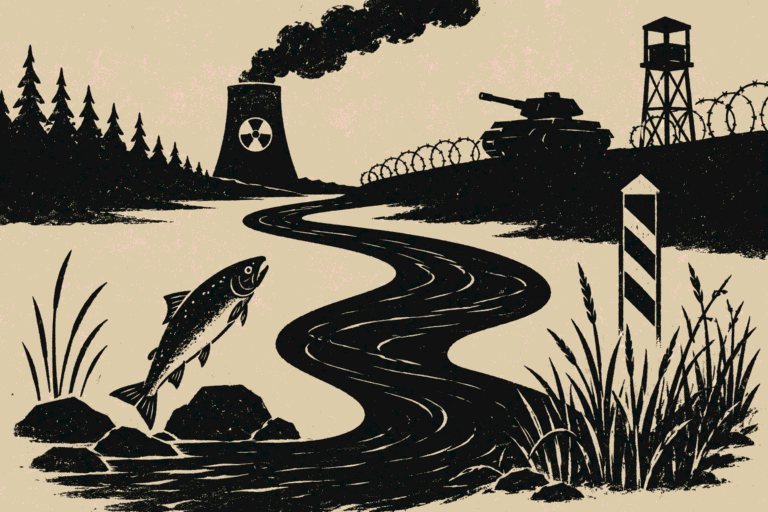
“The Neris on the Frontline: When a River Becomes a Battleground Between War, Nuclear Risk and Nature”. European Environmental Bureau, 5 February 2026: environmental and transboundary risks in the Neris–Viliya river basin. [76]
In 2025, Germany’s Federal Agency for Civic Education (bpb) published her Berlin speech on nonviolent resistance in Belarus. Extended interviews about her work have also appeared with ifa, Pax Christi France and the Belgian weekly Tertio. In October 2026, Our House reported Karach’s participation in a segment of the German ZDF programme frontal on forced labour in Belarusian penal colonies and international supply chains. [77][36][15][78][44]
Public recognition
In March 2002, the newspaper Svobodnye Novosti+ named Karach the most beautiful politician in Belarus. [79][80][17]
International networks and professional development
Karach’s international activities include work with EBCO, WIDE+, WILPF, PeaceWomen Across the Globe and the EENCE civic education network. In the 2020 ResiliENCE for EENCE project, she was listed among the organisers and contact persons of a programme supporting civic educators and community leaders. [38][14][81][82][40]
She completed the Community Connections programme in Jackson, Mississippi, USA, in 1999; the International Campaign School in Arlington in 2011; the IRI and CEVRO Rising Stars programme and the Vital Voices Poland mentoring programme in 2012; the Human Rights Defenders Advocacy Programme of the International Service for Human Rights in Geneva and the ISET Summer School organised jointly with the Prague Civil Society Centre in 2019; and the Open Society Foundations Strategic Communications programme in 2021. [31][28]
In 2021, she participated in the Leadership Academy for Development course in Prague, conducted by Francis Fukuyama and Erik Jensen together with the Boris Nemtsov Foundation. This fact and her status as an alumna of the programme are confirmed by Stanford University. [10]
Environmental advocacy and water diplomacy
Olga Karach’s environmental work focuses on the transboundary Viliya–Neris river basin, risks associated with militarisation and nuclear infrastructure, and public participation in decisions affecting nature and human security. Her article published by the European Environmental Bureau addresses these issues. [76]
In September 2026, Karach was invited to an expert discussion on women’s leadership in water diplomacy and peacebuilding organised by the Geneva Water Hub and Global Water Partnership — Mediterranean. The discussion connected women’s participation in transboundary water governance with conflict prevention and sustainable peace. [83]
Repression and criminal prosecution
Karach’s civic and journalistic activities have been accompanied by detentions, fines and criminal prosecution in Belarus. In 2011, her detention and allegations of ill-treatment were included in a joint communication by UN special rapporteurs to the Belarusian government. Document BLR 7/2011 describes her detention on 19 April, custody pending trial and a fine imposed on 20 April. [84]
In 2021, the KGB included her in the list of persons whom the Belarusian authorities associate with “terrorist activities”. In 2021–2022, Our House resources and channels associated with Karach were designated “extremist materials”; in May 2022, the Ministry of Internal Affairs designated Our House an “extremist formation”. [85][86]
On 8 July 2024, the Brest Regional Court sentenced Olga Karach in absentia to twelve years’ imprisonment and a fine of 15,000 base units — 600,000 Belarusian rubles, approximately €170,000 at the time of sentencing. The case was linked to participation in the Forum of Democratic Forces of Belarus. [87][32]
Karach is listed in the database of the Human Rights Center Viasna among political prisoners and politically persecuted persons. EBCO, War Resisters’ International, IFOR, Connection e.V. and PeaceWomen Across the Globe condemned her prosecution, linking it to her human rights and peacebuilding work. [88][14][40]
On 18 December 2024, eight UN special procedure mandates sent communication AL BLR 8/2024 to the Government of Belarus concerning the in absentia criminal prosecution of Karach and other Belarusian public figures. The communication raised questions concerning fair trial guarantees, effective legal defence, property rights, freedom of expression and the use of “special proceedings”. [16]
Life in Lithuania and disability
Since March 2020, Karach has lived and worked permanently in Vilnius. In 2023, Lithuania denied her political asylum on the basis of an assessment by Lithuanian state security authorities; Olga Karach rejected allegations of cooperation with any intelligence services and linked the decision to her work defending Belarusian refugees and Belarusian conscientious objectors in Lithuania. International human rights and peace organisations launched the #Protection4Olga campaign in her support. [15][5][14][68]
In Lithuania, Karach is officially recognised as a person with a disability. An identification document issued on 11 November 2024 indicates a participation level of 40 per cent. [89]
Notes and sources
[1] Radio Free Europe/Radio Liberty. Volha Karach. 6 April 2015. Independent biographical article. Education, youth activism, 2003 election, leadership in the United Civic Party, 2010 award.
[2] International Service for Human Rights — profile of Olga Karach. Human rights defender profile: women, children and juvenile prisoners. The page is dated 16 December 2019; the text was subsequently updated and mentions later awards.
[3] McCain Institute. Women, Peace and Security: The Role of Women in Belarus
[4] Olga Karach. Nuclear Weapons in Belarus: What We Know. ICAN. 22 November 2024
[5] Current Time — biographical note and asylum denial. 18 August 2023. Independent media source confirming authorship of Chinovniki.info and residence in Vilnius since 2011.
[9] Our House TV. Public YouTube channel page. When checked on 11 November 2026, the page showed 42,701,370 views and 75.7 thousand subscribers. Channel created on 11 May 2010.
[10] Stanford University — Weimar Human Rights Prize. 14 December 2022. University publication. Weimar Prize and participation in LAD in Prague in 2021. Some information on earlier awards cites Our House.
[11] die schwelle Foundation — Bremen Peace Award 2019. Awarding organisation. Category Friedensarbeiterin an der Basis; civic campaigns, transparency and government accountability.
[12] Fondazione Alexander Langer — list of award recipients. The awarding organisation lists Olga Karach as the 2023 recipient.
[13] International Peace Bureau — Seán MacBride Peace Prize 2023. Working URL of the awarding organisation replacing the shorter link from the original PDF. Joint prize to three organisations, including Our House.
[14] EBCO, WRI, IFOR, Connection — statement of 9 July 2024. Confirms board membership in EBCO, the sentence of 8 July 2024 and international reaction; assessments of the motives for prosecution belong to the authors of the statement.
[15] Pax Christi France. Human Rights in Belarus. Interview with Olga Karach. 5 December 2024
[16] United Nations. Joint communication of special procedures AL BLR 8/2024. 18 December 2024
[17] Our House. Amnesty International Named Olga Karach Human Rights Defender of the Year: A 2005 Retrospective. 25 November 2025. The retrospective dates the award to 2005; several earlier biographies give 2007.
[18] City of Weimar — statement on international recognition. 9 August 2023. Official municipal source. 2022 award, children’s rights, equality, protection of activists; statement on Nobel Peace Prize nomination.
[19] International Peace Bureau — press release, 13 October 2023. Additional official confirmation of the prize and description of Our House’s work for women, children and conscientious objectors.
[20] DFG-VK — Ludwig Baumann Prize 2024. Announcement of the award ceremony on 4 October 2024. Karach is listed among the recipients; a later interview confirms her status as a laureate.
[21] DFG-VK — interview with the laureate, 20 January 2025. Additional material on peacebuilding and antimilitarist activities after the Ludwig Baumann Prize.
[22] Brescia Peace Festival — 2025 programme. Organisers’ programme explicitly lists the 2025 Premio Brescia per la Pace for Olga Karach.
[23] WILPF Finland — Peace Ambassador 2026. 3 September 2026. Partner network report on the award presented on 22 August 2026. The text is identified as being based on an Our House publication and therefore is not entirely independent confirmation.
[24] Movimento Nonviolento — Premio Poeti Sociali 2026. 29 October 2026. Report on the 23 October 2026 presentation and the award citation for assistance to persecuted people and conscientious objectors.
[25] International Peace Bureau — intention to nominate organisations for the 2024 prize. Press release dated 4 August 2023 concerning three organisations and the intention to submit nominations. It is not confirmation by the Nobel Committee.
[27] Nasha Niva — biographical article, 13 March 2021. Independent detailed article, including critical assessments. Confirms year of birth, graduation with honours and youth activities.
[28] Karach, Olga. Professional Biography 2026. Updated author version. Olga_Karach_Professional_CV_2026_FINAL(6).docx.
[29] Nasha Niva. Who finances the organisation that nominated Our House for the Nobel Peace Prize? 2023
[30] World BEYOND War — Five Criteria for Lasting and Just Peace Agreements. Biography of invited speaker: Master’s degree, Global Peacebuilders Summit 2017, Women’s Peace Dialogue and WILPF. The biography may have been supplied by the participants themselves.
[31] LinkedIn — professional profile of Olga Karach. Self-published source. Contains education and certificates from professional programmes; does not substitute for an independent biographical publication.
[32] International Society for Human Rights. Olga Karach was sentenced to 12 years in prison and fined 170,000 euros. July 2024. Contains biographical information, media work and an audience exceeding 40 million views and around 80,000 subscribers.
[33] Our House — organisation history. Own source. Distinguishes the newspaper founded in 2002, the civic campaign launched in 2004 and expansion of the network in 2005.
[34] Vitebsk Courier News. Stickers “Housing Maintenance Office — Give Quality!” appeared in Vitebsk
[35] United Nations — shadow report by Adliga and Our House to CEDAW, September 2016. Primary document on the UN website. Page 2 explicitly names the authors as Evgenia Ivanova and Olga Karach. Hosting does not imply endorsement of the report’s conclusions by the Committee.
[36] ifa. Women are Demanding Political Divorce. Interview with Olga Karach. 9 August 2021
[37] WIDE+ — Annual Report 2022 and 2023. Confirms the expert discussion of 15 March 2022 on repression against women and feminists in Belarus.
[38] WIDE+ — Members Update 2024 Issue 3. Confirms participation in the Working Group on Feminist Movement Building and the Langer Prize.
[39] WIDE+ — Beijing+30: Gender Equality and Climate Justice in a Changing World, 2025. Report presenting Karach’s views on militarisation, gender-based violence, refugee women and women’s participation in peace processes.
[41] Our House. Report on Children’s Rights in Belarus. 2019
[42] OSCE. Wolfgang Benedek’s Moscow Mechanism report on human rights violations in Belarus. ODIHR.GAL/68/20. 29 October 2020. Section on children’s and parental rights; footnote 113 refers to Our House’s report on the Non-Children’s Case campaign.
[45] Amnesty International — juvenile prisoners. 21 March 2019. Independent confirmation of violations in the cases of Emil Ostrovko and Vasili Savchenko. By